Ask about the exact system
The useful question is not “Can vinyl fencing rack?” but “Can this exact fence system rack enough for the grade on this property?”

A sloped yard does not automatically require one installation method. Compare stepped and racked fencing by panel compatibility, ground gaps, privacy, gates, drainage and the actual shape of the grade.
Choose the method that works with the selected fence system, slope, desired ground clearance, privacy requirements and gate layout.
The most important product question is: can this specific fence system rack enough for this specific slope?
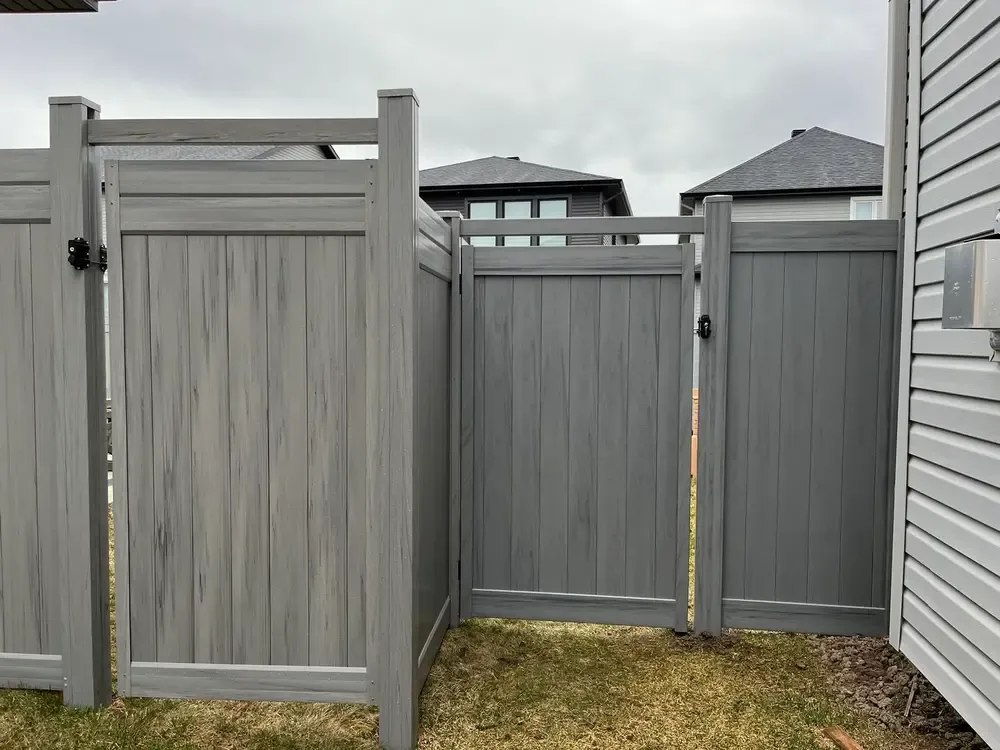
With a stepped fence, each individual section remains level. The next section begins lower at the following post, creating a staircase effect down the slope.
Stepping can create triangular gaps beneath the downhill end of each section. Those openings matter for privacy, pets and the finished appearance.

A racked section angles with the slope so the rails follow the grade rather than remaining level.
Racking can reduce the repeated bottom gaps produced by stepping and create a more continuous top and bottom line.
Rackability is product-specific. A vinyl or PVC label by itself does not tell you how much slope a particular panel can accommodate.
| Consideration | Stepped fence | Racked fence |
|---|---|---|
| Panel orientation | Level | Angled with grade |
| Top line | Stair-step appearance | Follows slope more continuously |
| Bottom line | Stepped | Usually follows grade more closely |
| Ground gaps | Can be larger | Usually smaller |
| Product compatibility | Useful for rigid sections | Requires a rackable system |
| Steep grade | Often easier to accommodate | May exceed product limits |
| Privacy near ground | Needs careful planning | Often more consistent |
| Gate integration | Separate gate planning required | Separate gate planning required |
Racking limits can depend on the panel width, rail design, routed openings, infill geometry and manufacturer instructions.
The useful question is not “Can vinyl fencing rack?” but “Can this exact fence system rack enough for the grade on this property?”
Photos and individual run measurements help identify where the slope is gentle, where it changes sharply and where a stepped transition may be required.
A fence can meet the intended height and still perform poorly for privacy or pet containment if large openings are created at the ground.
View the slope from patios, windows and neighbouring grade. A stepped panel can reveal more beneath the fence than expected.
Small pets may use triangular gaps or gate clearances as escape routes. Pet size and digging behaviour matter.
Changing grades can affect winter clearance around gates and low sections where snow is stored or pushed.
Sloped gate locations can create swing-clearance problems, large downhill gaps or awkward latch positions.
Where possible, a more level gate location may simplify the project. Where a sloped opening is unavoidable, the gate should be designed separately from the adjacent fence sections.

A slope may be carrying water toward a swale, catch basin or lower part of the property. Filling low areas or changing grade can create a different problem.
Keep existing drainage routes in mind when deciding how the fence crosses a low area.
Do not assume an existing retaining wall can automatically support a fence. Structure, ownership and drainage all matter.
Ottawa-area soil conditions can make post support and drainage especially important. Material choice does not replace proper post planning.
Common questions about grade transitions, racking, stepping and gates.
No. Racked sections angle with the grade, while stepped sections remain level and move down the slope in stages.
Racking generally follows the ground more closely, but the actual clearance depends on the fence system, panel geometry and terrain.
Some privacy systems can rack to a limited degree while others must be stepped. The installation instructions for the selected system should control the decision.
It is often useful when the grade exceeds a panel's racking capability, but the best approach depends on the fence system and the way the grade changes.
Yes in some layouts, but the gate needs separate planning for swing clearance, bottom gaps, latch alignment and the transition to adjacent fence sections.
Do not change significant grades or drainage routes simply to make a fence easier to install. Grade changes should be evaluated with drainage and site conditions in mind.
West Wholesale can help compare compatible fencing options for sloped Ottawa-area properties and plan the fence around grade, gates, ground clearance and site conditions.