Full privacy solves direct views
If two patios are at similar elevations and directly face each other, a full-privacy section can be the most straightforward way to interrupt the view.

Choose full privacy when blocking direct sightlines is the main goal. Choose semi-privacy when filtered screening is enough and airflow, light or a less enclosed yard matters.
Full-privacy fencing is best for strong direct screening. Semi-privacy fencing is useful where filtered views, airflow and a lighter visual effect are desirable.
The best fence often depends on where people sit and look—not simply on the percentage of the panel that appears solid.
Full-privacy fencing uses a solid or effectively opaque infill intended to prevent direct views through the fence face.
It is commonly considered where neighbouring outdoor spaces are close or where a long boundary needs consistent visual screening.
Full privacy through the panel does not guarantee complete privacy from higher neighbouring decks, windows or upper storeys.


Semi-privacy fencing intentionally allows some openings, filtered sightlines or decorative gaps rather than creating one continuous opaque surface.
Depending on the system, that can include spaced vertical infill, horizontal slats, lattice sections or combinations of solid and open areas.
“Semi-private” is not one standardized amount of openness. Two products in the same category can create very different sightlines.
| Consideration | Full privacy | Semi privacy |
|---|---|---|
| Direct visibility through panel | Very low or none | Partial |
| Air movement | More restricted | Greater |
| Light through panel | Low | Greater |
| Visual enclosure | Higher | Lower |
| Wind pressure on panel face | Generally greater | Openings can reduce pressure |
| Pet containment | Strong when lower gaps are controlled | Depends on opening size |
| Small-yard feel | Can feel more enclosed | Often feels more open |
| View preservation | Minimal | Possible |
Stand where privacy matters, then look toward the person, property or activity being screened.
If two patios are at similar elevations and directly face each other, a full-privacy section can be the most straightforward way to interrupt the view.
Where shrubs, grade changes or building orientation already provide partial screening, a more open fence may preserve light and airflow without sacrificing the privacy that actually matters.
Solid panels restrict more airflow and receive more wind pressure. Semi-private openings allow more air to pass through.
A full fence can create more shade near the boundary. This matters beside gardens, patios and narrow side yards.
A tall continuous solid fence can make a compact yard feel visually smaller. Semi-privacy can soften that enclosure.
Check the actual opening size, gate gaps and bottom clearance rather than choosing based on the category name alone.
A privacy fence is not automatically a soundproof wall. Noise control depends on height, gaps, distance, source elevation and barrier construction.
Open lots and corner properties need complete-system planning: fence height, posts, footings, panels and gates all matter.
A backyard can use stronger screening where neighbouring patios align and a more open fence where there is no direct view to block.
For example:
Mixing systems works best when transitions, colours and overall fence height are planned as one project rather than added randomly over time.
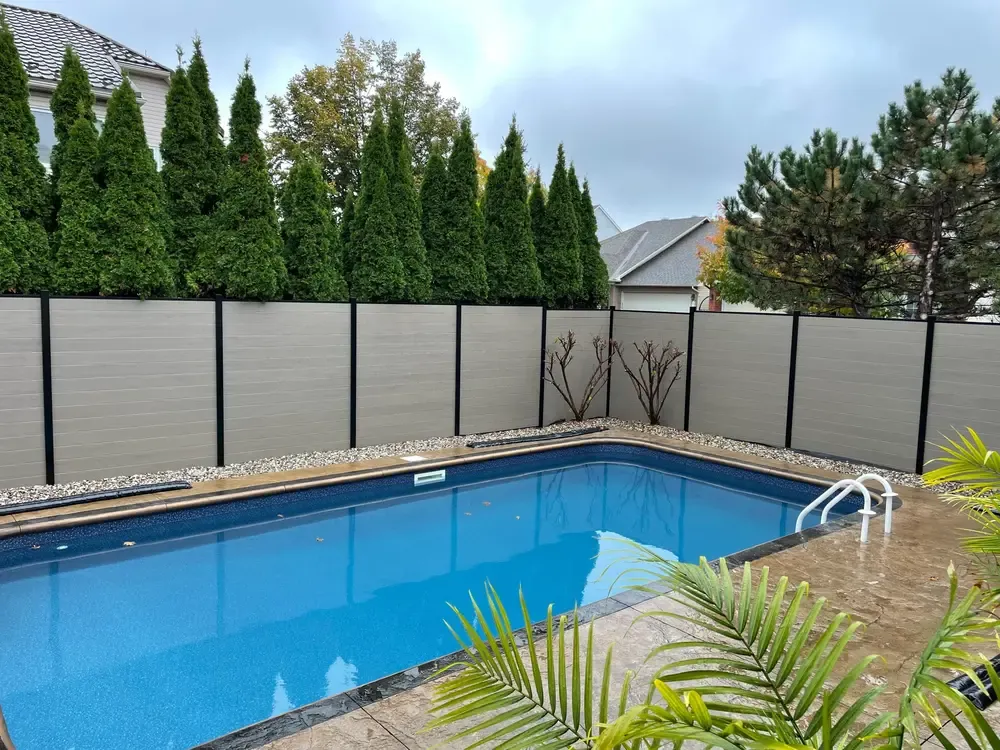
Direct sightlines are the main problem, neighbouring spaces are close and openings through the panel are undesirable.
Filtered screening is enough, airflow matters and the yard should feel lighter or less enclosed.
Different parts of the yard solve different problems and a single fence style would be unnecessarily restrictive.
Common questions about screening, airflow, wind and mixed privacy layouts.
Usually to some degree. Visibility depends on the size and direction of the openings, viewing angle, distance and the relative grade on both sides.
The solid lower section can provide strong privacy, while the lattice or open upper section allows partial visibility and airflow.
Openings can reduce the amount of wind pressure acting on the fence face, but structural performance still depends on the complete post, footing, rail and panel system.
Not necessarily. Direct screening can be valuable beside a patio, but light, airflow, yard size and the actual sightline should also be considered.
Yes. A property can use stronger privacy where neighbouring patios align and a more open design where views or airflow are more important.
It depends on opening size, bottom clearance, gate gaps and the pet's size and behaviour. The label full privacy or semi privacy is not enough by itself.
West Wholesale can help compare full-privacy, semi-privacy and other PVC or vinyl fence configurations based on the way the property is actually used.