Whole-boundary problem
If adjoining yards face each other along most of the property line, a continuous privacy fence can be the cleaner solution.

A privacy fence usually makes more sense for continuous boundary screening and enclosure. A privacy wall is often better when the unwanted view is limited to a patio, deck, hot tub or one specific outdoor zone.
If most of the property boundary needs screening, compare privacy fences. If one patio or seating area has a specific sightline problem, compare privacy walls or screens.
The best privacy solution is often the one positioned where the sightline occurs—not the one using the most material.
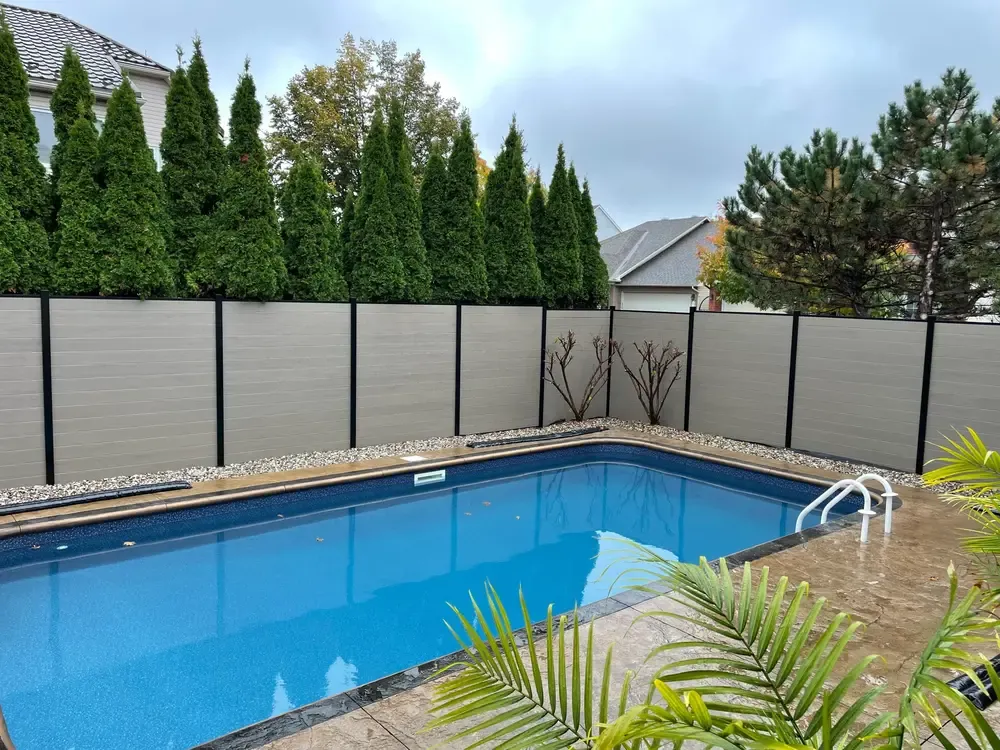
A privacy fence is generally a continuous fencing system designed to define a boundary while preventing direct views through its panels.
It can serve several functions at the same time:
For a typical backyard, a privacy fence may continue across multiple property lines and connect the house to rear or side boundaries.

In residential outdoor design, a privacy wall or screen usually refers to a more localized screening element rather than a full perimeter enclosure.
It may be positioned beside:
Supplier and municipal terminology can vary. The actual construction, location, height and attachment method matter more than the marketing name.
| Consideration | Privacy fence | Privacy wall |
|---|---|---|
| Coverage | Long boundary runs | Localized area |
| Primary purpose | Enclosure + screening | Targeted screening |
| Gates | Common | Usually unnecessary |
| Pet containment | Can form a complete enclosure | Usually incomplete |
| Boundary definition | Strong | Limited |
| Patio privacy | Works but may cover more area than needed | Highly targeted |
| Second-storey sightlines | Depends on location and allowable height | Strategic placement can help |
| Visual enclosure | Whole-yard effect | Localized effect |
A screen positioned close to the protected area can sometimes interrupt a view more efficiently than a distant boundary fence.
If adjoining yards face each other along most of the property line, a continuous privacy fence can be the cleaner solution.
If privacy is lost only where a neighbour's patio or window aligns with one seating area, a strategically placed wall can solve that specific view without closing the entire yard.
A privacy fence usually provides clearer long-run screening and a consistent enclosure.
A localized privacy wall can protect one outdoor zone without adding solid fencing around the entire property.
A nearby screen can improve certain sightlines, but allowable height and structure still limit what can be built.
Continuous fencing is usually more appropriate because a wall alone can be bypassed around its ends.
Localized walls affect a smaller portion of the yard, while long solid fences create a larger wind barrier.
Fencing can control entry to an enclosed yard. Privacy walls generally do not need a gate unless part of a larger enclosure.
A deck guard, freestanding fence and privacy screen do not automatically have the same structural role.
Do not attach a large solid screen to an existing railing simply because the panel can be physically fastened there. The added wind load and connection details need to suit the deck and railing configuration.
Where a privacy wall interacts with a deck, consider the assembly as a system rather than a decorative add-on.

Different parts of a yard often have different privacy requirements.
Use a privacy fence where the full property line needs consistent screening.
Use semi-private or more open fencing where light and airflow matter.
Add a localized privacy wall where one direct sightline remains after the perimeter is planned.
Common questions about localized screens, enclosure, sightlines and deck applications.
Not necessarily. Privacy wall is commonly used for a localized screen, but terminology varies. Construction, attachment, location and function matter more than the label.
Some systems are designed for deck applications, but the structure, connections and wind loading need to be appropriate for the deck and railing configuration.
If the issue affects most of a boundary, a privacy fence may be more appropriate. If the problem is limited to one seating area, a localized privacy wall may be more efficient.
Strategic placement can improve some sightlines because the screen is closer to the protected area, but allowable height and structural requirements still matter.
A standalone wall usually does not create a complete enclosure. A fence is generally more appropriate where full pet containment is required.
Yes. That combination can preserve light and airflow around most of the yard while providing stronger screening beside a patio, deck or other exposed area.
West Wholesale can help compare privacy-wall and fencing systems after the coverage, outdoor use and viewing angles have been defined.