Ottawa homeowners often hear that local fences need to be “built for Leda clay.” The phrase is useful, but it can also oversimplify what is happening beneath a fence.
Sensitive marine clay is present in many parts of the Ottawa region, but soil conditions can change between neighbourhoods—and sometimes within the same property. Fence stability is therefore affected by more than the word clay. Moisture, drainage, frost penetration, post design, footing shape, fence height, wind exposure and installation consistency all matter.
This guide explains how Ottawa’s clay soils can influence fence posts, what warning signs homeowners should watch for and what should be considered when planning a new fence.
Quick answer: Can Leda clay make fence posts move?
Yes. Fine-grained, moisture-sensitive soil can contribute to fence-post movement when it freezes, becomes saturated, dries unevenly or transfers frost-heaving forces to a post or concrete footing.
However, Leda clay does not automatically mean that every fence will fail. A stable fence depends on how the actual site conditions are assessed and how the posts, drainage and fence system are designed together.
What is Leda clay?
Leda clay is a commonly used name for sensitive marine clay found in parts of eastern Ontario and western Quebec. The material was deposited when areas of the Ottawa and St. Lawrence valleys were covered by the Champlain Sea after the last glaciation.
Research from the National Research Council of Canada has examined Leda clay taken from the Ottawa region and documented its sensitive structure. In geotechnical terminology, “sensitive” means that the soil can lose a significant amount of its natural strength when it is heavily disturbed or remoulded.
For a residential fence project, homeowners do not need to become soil engineers. The practical point is that some Ottawa clay deposits can:
- Hold considerable moisture.
- Change volume as moisture conditions change.
- Be susceptible to frost action.
- Behave differently when disturbed.
- Vary considerably in depth and composition across the city.
The City of Ottawa recognizes sensitive marine clay as an important local soil condition. City guidance addresses its relationship with foundations, tree planting and development in affected areas.
Is every Ottawa property built on Leda clay?
No. “Ottawa soil” is not one uniform material.
Some properties have deep marine clay. Others may contain sand, silt, fill, glacial till, shallow bedrock, construction debris or combinations of several materials. Soil can also vary along one fence line.
For example, a post near a house may encounter compacted construction fill, while a post at the rear of the yard may encounter softer native soil. A low section may remain wet after rain, while another section drains quickly.
That is why homeowners should be cautious about installation advice that prescribes one footing detail for every Ottawa property. Local experience is useful, but the conditions found during excavation still matter.
How does clay contribute to fence-post movement?
Several different mechanisms can produce a fence that leans, lifts or loses alignment. They are related, but they are not identical.
1. Frost heave can lift a post or footing
Frost heave is more complex than water simply expanding when it freezes.
National Research Council research explains that significant frost heave involves three conditions:
- Freezing temperatures.
- Frost-susceptible soil.
- A source of water.
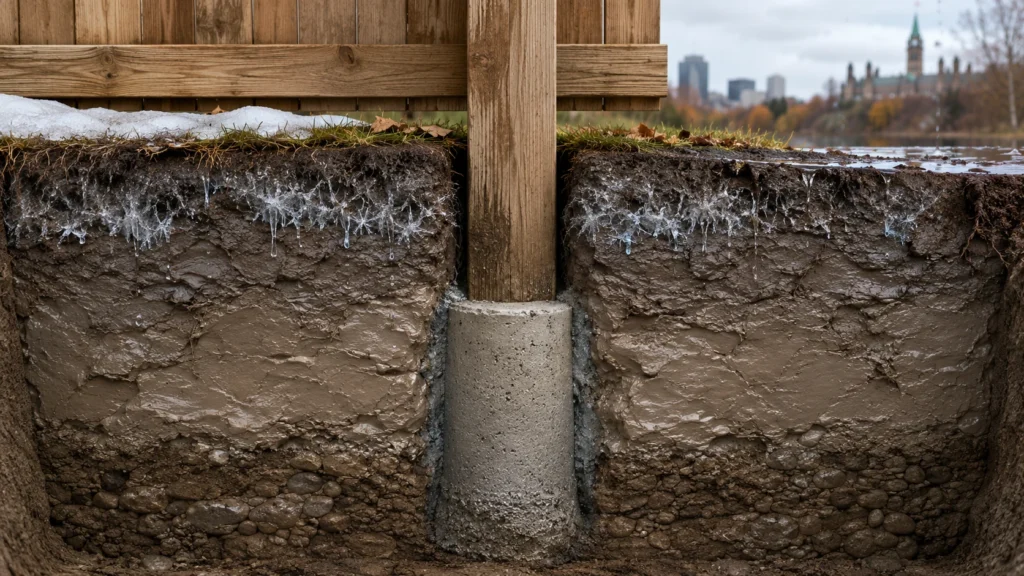
As the freezing front moves through fine-grained soil, water can migrate toward it and form layers of ice known as ice lenses. The growth of these lenses can lift the surrounding soil and anything connected to it. Compact fine-grained soils can develop substantial heaving pressure under the right moisture and freezing conditions.
A post does not always return to its original position when the ground thaws. Repeated seasonal movement can gradually leave a fence higher, lower or farther out of plumb than when it was installed.
2. Frozen soil can grip the side of a footing
Frozen soil may adhere to the surface of a post or footing. This process is often called adfreezing.
Field research conducted in frost-susceptible Leda clay found that freezing soil transferred uplift forces to small steel, concrete and wood columns. This means a footing can be affected not only by pressure beneath it, but also by frozen soil gripping its sides.
This is one reason the complete footing design matters. Depth is important, but so are footing shape, surface, diameter, backfill and the soil surrounding the upper portion of the footing.
3. Clay can shrink during dry conditions
Ottawa’s clay-related movement is not limited to winter.
Sensitive marine clay can shrink when it loses moisture. If one part of a fence line dries more than another, the soil may settle unevenly. The City of Ottawa identifies uneven shrinkage of sensitive marine clay as a contributor to local foundation movement. A fence is much lighter than a building, but the same moisture variability can still be relevant when considering shallow posts and surface conditions.
Nearby trees, prolonged dry weather, altered grading and changes to surface drainage can all affect how moisture is distributed through a yard.
4. Saturated soil may provide weaker support
Clay drains more slowly than coarse sand or gravel. Water may remain around a post after heavy rain, rapid snowmelt or irrigation.
Saturated ground can reduce the lateral support available to a post. If the fence also receives strong wind loads, snow pressure or repeated gate movement, the post may begin to lean even without obvious upward heaving.
This is why drainage should be considered as part of fence planning rather than treated as an unrelated landscaping issue.
What are the warning signs of soil-related fence movement?
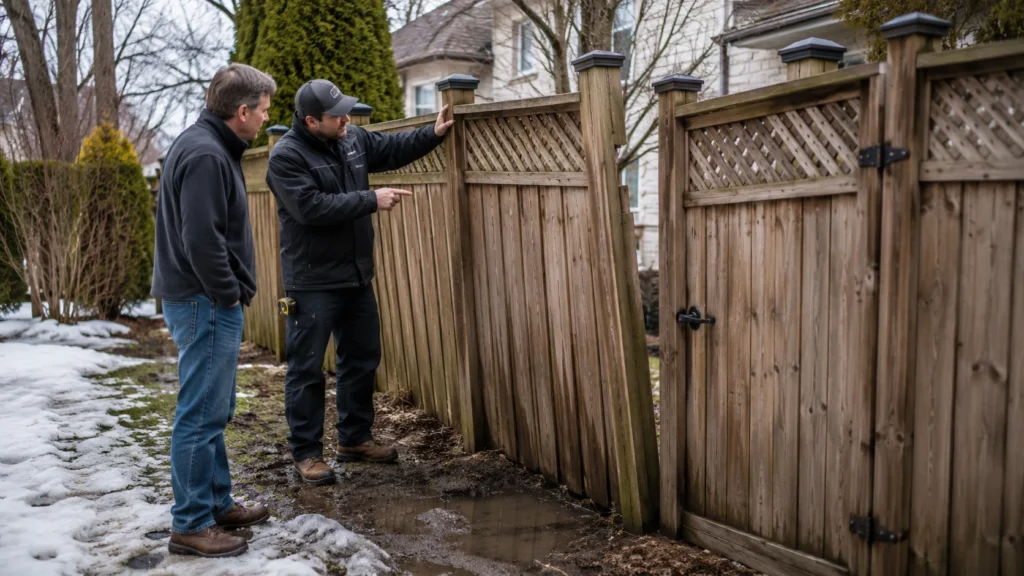
A moving fence does not always fail suddenly. Small changes often appear first.
Inspect for the following signs:
- One post sits higher than neighbouring posts.
- A gap has appeared beneath one fence panel.
- The top of the fence line has become uneven.
- A post leans despite appearing sound above ground.
- Soil has pulled away from one side of a footing.
- A concrete collar has risen above the surrounding grade.
- A gate rubs, drags or no longer reaches its latch.
- Rails or panels are twisting between posts.
- Movement becomes more noticeable after winter or spring snowmelt.
- The same post requires adjustment repeatedly.
A gate is often one of the first places movement becomes obvious. Gates depend on precise alignment, and their posts carry additional weight and repeated operating forces. A small amount of post movement that is barely visible in a fence panel can make a gate difficult to close.
Does a leaning fence always mean frost heave?
No. Several problems can create similar symptoms.
A fence may lean because of:
- A shallow or poorly shaped footing.
- Inconsistent post installation.
- Loose or inadequately compacted backfill.
- Decayed wood at or below grade.
- A damaged post or connection.
- Wind loading on a solid privacy fence.
- Soil erosion or runoff.
- Vehicle, snowplow or impact damage.
- Heavy snow piled against the fence.
- Tree-root activity.
- A gate that is too heavy for its post.
- General soil settlement.
Determining the cause matters because the correct repair for a rotted post is different from the repair for a sound footing that has been lifted by seasonal soil movement.
What makes a fence-post installation more stable in Ottawa clay?
There is no single installation detail that is appropriate for every Ottawa property. A stable system normally requires several factors to work together.
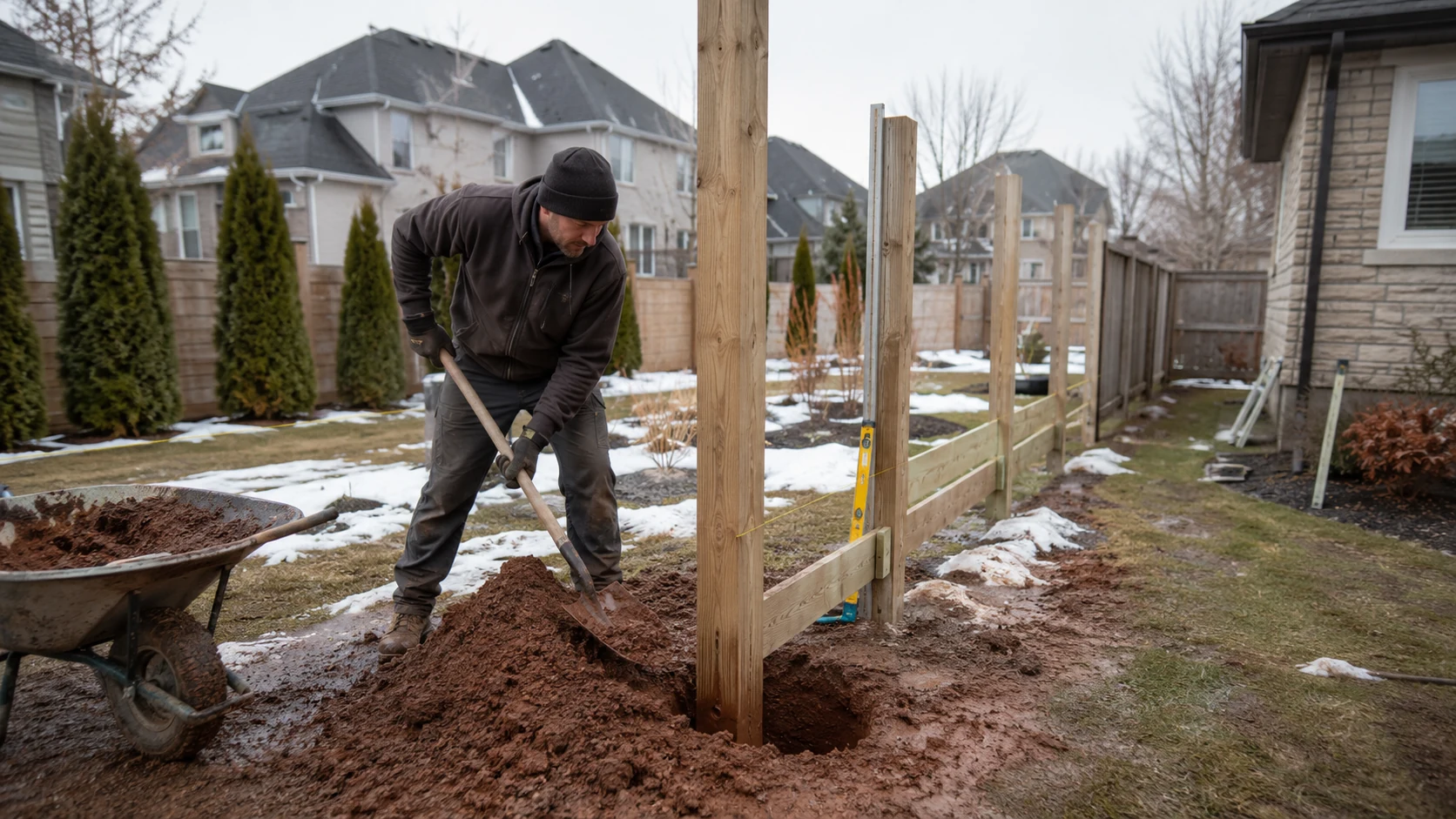
Site-specific excavation
The installer should evaluate what is actually found in the post holes. Dense native clay, loose fill, wet silt, stones and shallow bedrock may require different equipment or installation decisions.
A plan should not assume that every hole will behave identically simply because the properties are on the same street.
Appropriate footing depth and geometry
Post depth should account for local frost conditions, fence height, wind exposure, soil conditions and the loads placed on the post.
The bottom and sides of the footing also matter. A footing should not unintentionally be shaped like a tapered plug that surrounding frozen soil can lift more easily. The appropriate detail depends on the post material and installation system.
For a broader explanation, see West Wholesale’s guide to the factors that influence fence-post depth.
Consistent post placement
A fence is a connected system. If one post is installed differently from the rest, movement at that post can distort adjacent rails, panels and gates.
Consistency includes:
- Post spacing.
- Hole diameter.
- Footing depth.
- Alignment.
- Bracing during curing.
- Backfill and compaction.
- Connection details.
- Finished grade around each post.
Drainage around the fence line
Surface water should not be directed toward the posts.
Homeowners and installers should look for:
- Downspouts discharging near the fence.
- Low areas that collect spring meltwater.
- Irrigation repeatedly soaking one section.
- Patio or driveway runoff flowing toward a gate.
- Soil grading that traps water against concrete.
- Erosion exposing part of a footing.
Adding loose stone to a hole does not automatically solve a drainage problem. In poorly draining clay, an isolated pocket of stone can potentially become a place where water collects if there is no route for that water to escape.
The larger question is where the water comes from and where it can safely go.
Extra consideration for gates and exposed fences
A solid privacy fence catches more wind than an open fence. Gate posts also support weight, hinges and repeated movement.
These higher-load sections may need a different post or footing approach than an ordinary intermediate post. A design should account for the whole fence system rather than treating every post as interchangeable.
Should concrete always be used around fence posts?
Concrete can provide strong lateral support and is commonly used in fence installations. It does not, by itself, guarantee protection from frost movement.
A concrete footing can still move when:
- It ends within frost-susceptible soil.
- Frozen soil grips its sides.
- The hole has an unfavourable shape.
- Water accumulates around it.
- The surrounding ground has been disturbed or poorly compacted.
- The post and footing are undersized for the applied load.
The right question is not simply, “Was concrete used?” It is, “Was the entire post-and-footing system appropriate for this site?”
Homeowners should also be careful with universal online instructions. Methods suitable for a wood post may not be identical to those used for a metal, vinyl or hybrid fence system.
Do homeowners need a soil test before installing a fence?
Most routine residential fence projects begin with a site assessment rather than a formal geotechnical investigation.
More detailed professional input may be sensible when a proposed fence is near:
- A steep or unstable slope.
- A retaining wall.
- A ravine or erosion-prone area.
- A foundation with known movement.
- A major grade change.
- Deep, soft or unusually wet soil.
- A location with recurring post movement.
- A heavy gate or unusually tall privacy structure.
- Areas where previous excavation encountered difficult soil conditions.
This is a risk-based decision rather than a requirement for every backyard. The objective is to recognize when a normal fence installation is becoming a more complicated ground or structural problem.
Ottawa clay-soil fence planning checklist
Before approving an installation plan, ask the following questions.
Property and layout
- Has the property line been confirmed?
- Are easements or shared access areas involved?
- Will the fence alter existing drainage?
- Is the proposed line near a slope, retaining wall or large tree?
- Are any sections exposed to unusually strong wind?
Soil and moisture
- Does water remain along the fence line after rain?
- Where does snowmelt travel in spring?
- Are there signs of soft fill or previous excavation?
- Do nearby patios, sheds or fences show settlement?
- Are downspouts or irrigation systems directed toward the fence?
Post and footing plan
- How will post depth be determined?
- Will gate and corner posts receive additional consideration?
- How will footing shape and diameter be controlled?
- What happens if rock, fill or wet soil is encountered?
- How will posts be aligned and braced?
- How will excavated soil and excess concrete be managed?
Long-term performance
- What movement is covered by the workmanship warranty?
- What maintenance should the homeowner perform?
- When should the fence be inspected after installation?
- Who should be contacted if a gate begins to lose alignment?
Common mistakes to avoid
Assuming every Ottawa yard has identical soil
Neighbourhood reputation is not a substitute for examining the actual fence line.
Choosing post depth from a generic online chart
Fence height is only one consideration. Soil, moisture, footing design, wind exposure and gate loads also matter.
Treating drainage as a problem for later
Changing the grade after a fence is installed can direct new runoff toward the posts.
Assuming more concrete always means more stability
The location, geometry and interaction of the footing with the surrounding soil are more important than concrete volume alone.
Ignoring small gate-alignment changes
A dragging gate may be an early indication that a post is rotating, settling or lifting.
Straightening a post without identifying the cause
A cosmetic adjustment may not last if the footing, drainage or soil problem remains unchanged.
What should you do if your fence moved over winter?
Wait until the ground has thawed before making a final diagnosis. Frozen ground can temporarily hold a post in a position that changes again during spring.
Once conditions are suitable:
- Compare the post height with neighbouring posts.
- Check the post for decay, cracks or connection failure.
- Look for exposed or lifted concrete.
- Inspect nearby drainage and erosion.
- Test the gate and connected panels.
- Photograph the fence line from several angles.
- Determine whether the movement is isolated or widespread.
- Arrange an assessment before resetting or replacing the post.
West Wholesale’s spring fence inspection checklist can help organize this review.
Frequently asked questions
Can Leda clay cause a fence to lean?
It can contribute to movement, but it is rarely the only factor. Moisture, frost action, footing design, wind, drainage and installation quality determine whether soil movement becomes visible in the fence.
Is all clay soil in Ottawa Leda clay?
No. Ottawa properties may contain marine clay, silt, sand, till, fill, shallow rock or mixed soil profiles. A soil label should not be assumed without site information.
Will a frost-heaved fence post settle back down?
It may settle partially as the ground thaws, but it may not return to its original elevation or alignment. Repeated seasonal movement can become cumulative.
Does concrete stop frost heave?
Not automatically. Concrete can strengthen a post installation, but a poorly designed concrete footing can still be affected by frost-susceptible soil, moisture and adfreezing.
How deep should fence posts be in Ottawa clay?
There is no responsible universal answer based only on the word clay. Depth should be selected according to local frost conditions, soil profile, fence design, post type, footing system and applied loads.
Why does my gate stop closing after winter?
The hinge post, latch post or both may have moved slightly. Gates reveal small alignment changes quickly because they require precise spacing and level operation.
Can better drainage fix a leaning post?
Improving drainage may reduce future moisture-related movement, but it will not necessarily restore a damaged or displaced footing. The post and footing should be assessed separately.
When should a moving fence post be replaced?
Replacement may be necessary when the post is decayed, cracked, permanently bent, inadequately anchored or repeatedly moves after adjustment. A sound post may sometimes be reset, but the underlying cause should be addressed first.
Plan for the soil—not just the fence panel
Fence panels determine the appearance of a project, but posts determine whether the fence remains aligned.
On an Ottawa property, a responsible installation plan should consider soil variability, seasonal moisture, drainage, frost action, wind exposure and gate loads together. Leda clay is an important local consideration, but it should not be used as a shortcut for assuming that every yard needs the exact same solution.
Homeowners planning a new fence can explore fencing designed for Ottawa property conditions or contact West Wholesale to discuss the layout, material options and site conditions of their project.