
Solving a property line dispute requires a thoughtful and deliberate approach. It is possible to get your land back without starting a fight. The answer to the critical question, ‘Can I remove my neighbour’s fence on my property?’ lies in following the correct legal process. This guide explains the safe and proper steps to take to avoid fines and disputes.

Confirming Fence Ownership and Location
Before you do anything, you need to be 100% sure about two things: where your land ends and who the fence belongs to. Let’s see how you can find the facts:
- Professional Land Surveyor: A licensed expert can find the boundaries of your property. They use special tools to give you proof of where your land is.
- Get a Surveyor’s Real Property Report (SRPR): In Canada, this is a legal document that shows the property lines. It will also show the location of any buildings, sheds, and fences. If your neighbor’s fence is on your land, the SRPR will prove it.
- Property Documents: Check the documents you received when you bought your home. These can offer clues; however, they are not as precise as a new survey.

What Are the Shared Fences and Canadian Laws?
If the boundary is right on the property line, it is often shared, also called a line fence. Check these rules to know the differences:
- Shared Ownership: In most parts of Canada, a fence on the boundary line means both are responsible for it. You both share the cost of putting it up and keeping it in good shape. You cannot remove it or change it without your neighbor’s permission.
- Provincial and Municipal Laws: The rules change according to your city. Your local municipal office will have “bylaws” that explain the rules.
- The Line Fences Act: Some provinces, like Ontario, have a specific law called the Line Fences Act. This law provides a process for neighbors to resolve disputes over shared boundaries. It helps determine who pays for what and where the boundary should go.

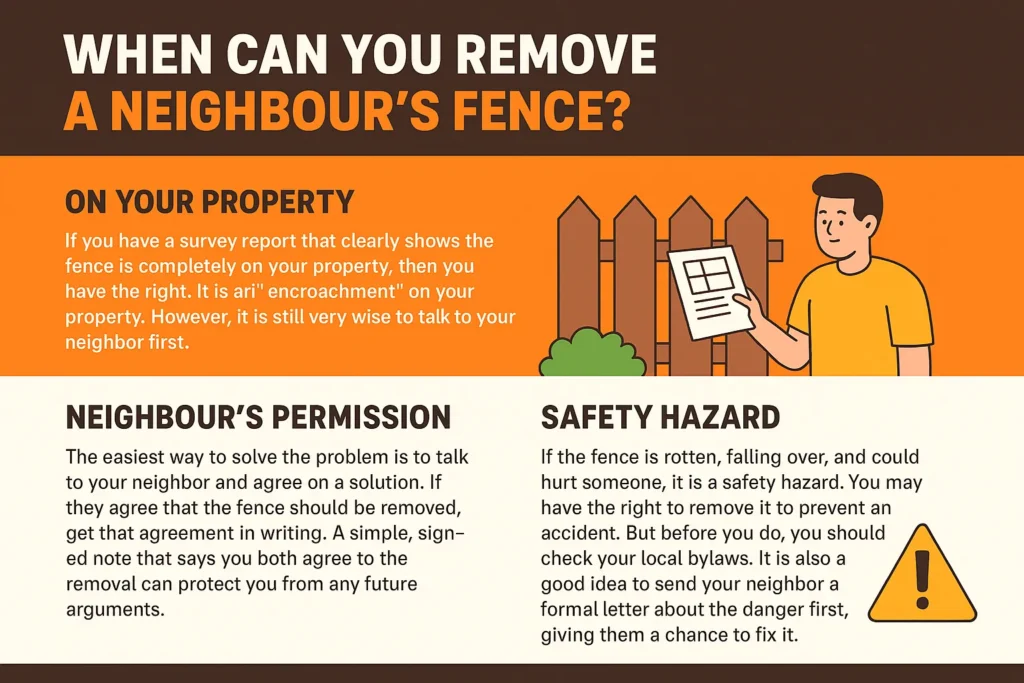
When Can You Remove a Neighbour’s Fence?
You can’t always remove a fence, even if it bothers you. But there are specific times like these when you have the right to take it down:
How to Handle Encroachment?
What happens if the fence has been on your land for many years? The law has special rules for long-term situations. “Encroachment” is the legal term for when a structure, like a fence, crosses over the property line.
In Canada, there is a rule sometimes called “adverse possession” or “squatter’s rights.” It means if a neighbor has used a piece of your land for a long time (often 10 years or more) without objection, they could legally claim that land. Because of this rule, it is important to deal with an encroaching boundary as soon as you discover it.
Extra Things to Consider Before Removal
Before you start tearing anything down, take a final moment to think about these points:
- Check Local Bylaws Again: Make sure you have not missed any specific local rules.
- Replacement Costs: If you remove the current one, will you need a new one? Think about who will pay for it.
- The Future Relationship: How will your actions affect your life next door? Sometimes, finding a compromise is better for long-term peace.
Planning your new boundary is the most important step.
Once the property line is confirmed, you have the opportunity to install a fence that offers security and peace of mind. Start exploring high-quality, durable options that will stand the test of time.
Browse Our Fencing Materials and Styles
Conclusion
So, can you remove a neighbour’s fence on your property? Yes, but only when you are sure it is fully on your land. Always start with a survey to get proof. Then, talk to your neighbor and check your local bylaws. By being fair and following the rules, you can solve the problem in a calm and legal way.
Navigating a boundary dispute is tough, but building the right fence afterward shouldn’t be. Our experts can help you select the perfect materials and provide a clear quote to get your project done right.
Contact Us for a Free Consultation and Quote